Foraminifera.org makes its debut at FORAMS 2026
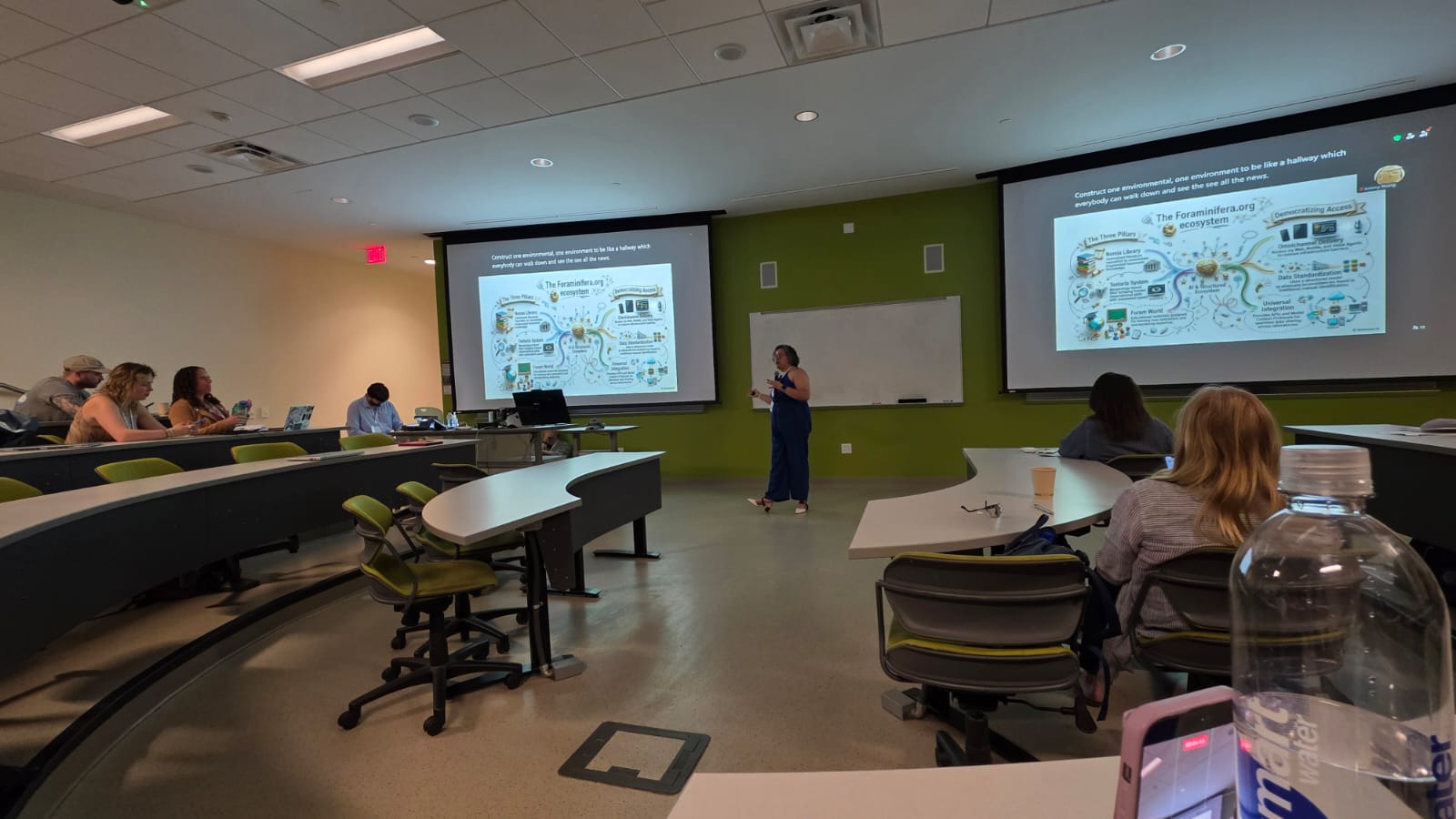
This week at FORAMS 2026 — the International Symposium on Foraminifera, held at the University of Massachusetts Amherst from June 21–26 — our founder, Patrícia Helena Martha Silveira, presented foraminifera.org and its full structure to the foraminiferal research community.
An open platform for a shared bottleneck
Foraminiferal species identification is slow and error-prone — not for lack of skill, but because the knowledge is fragmented across disconnected catalogs, publications, and institutional archives, with morphological terminology that varies from author to author. Foraminifera.org exists to fix that. It is a long-term, open-science platform that aggregates and characterises: adding the morphological character matrix, specimen images, ecology, and an identification filter, while keeping taxonomy synchronised to WoRMS and never forked.
Three pillars, one shared backbone
The platform was presented as three complementary, independent sub-projects:
- Nomia Library — an AI pipeline that turns scientific PDFs into structured, provenance-tracked bibliographic and taxonomic data.
- Testaria System — a faceted morphological search engine: observe the specimen, select the characters you see, and receive a ranked list of candidate species with full provenance.
- Foram World — a future open educational layer that turns the dense scientific catalogue into structured learning materials and visual guides.
Each pillar is independent, but they share a single data layer keyed by the WoRMS AphiaID, with mandatory provenance on every record. Taxonomy always flows from WoRMS — the platform characterises and connects; it never forks the tree.
Why present it now
Foraminifera.org is honest about its stage: it is Pre-MVP. The WoRMS-anchored data layer is ingested, the Testaria identification filter runs as an MVP demo on mock data, and the full ingestion pipeline is in design. Presenting at FORAMS 2026 is precisely the point — the platform is being shaped openly, and the people who do this work every day are the ones best placed to shape it.
The researcher sees the specimen and recognises the characters — coiling mode, chamber arrangement, aperture type, wall structure. The filter reduces the universe of possible species without requiring them to guess order, family, or genus.
If you work with foraminifera and want to help shape an open, FAIR, community-governed infrastructure for the field, read more about the platform or get involved. The door is open.